









Search

Please enter a keyword or what you are looking for in the field below to search.

alt
Search result
There is no result for your search, please check again.
    alt alt alt alt
    alt alt alt alt
    alt

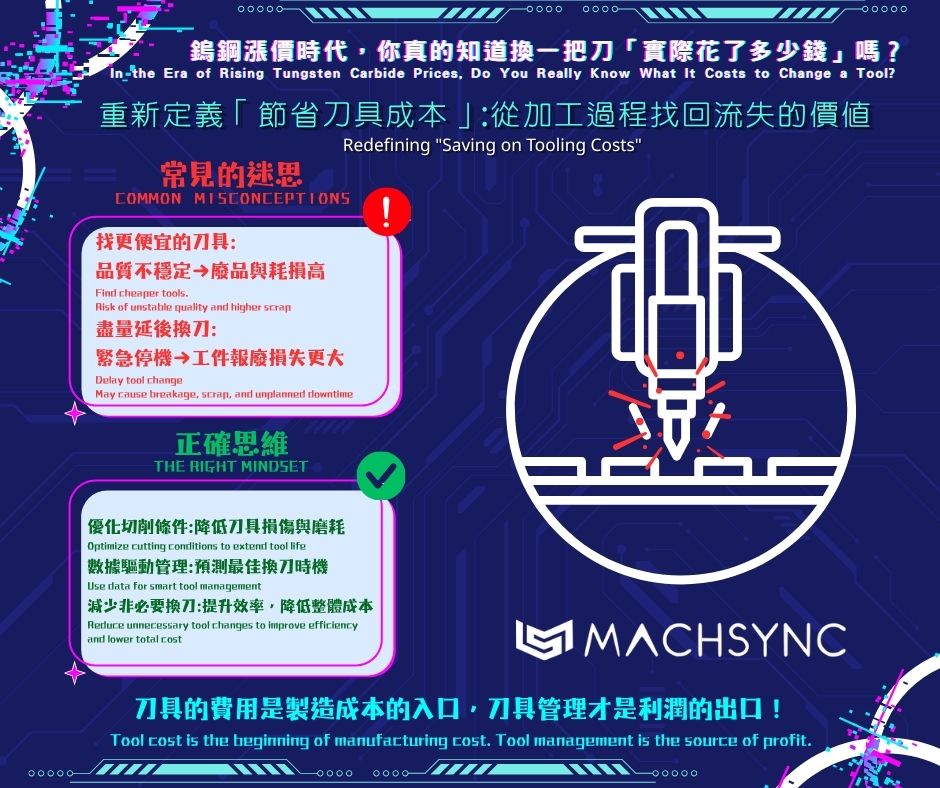
    In the Era of Rising Tungsten Carbide Prices, Do You Really Know What It Costs to Change a Tool?

    Raw material markets wait for no one. In recent years, the sustained rise in tungsten carbide prices has left many machining plant managers catching their breath when they receive purchase quotes. Yet while our attention is fixed on the buying price of the tool itself, we often overlook a far more critical question: the true cost of a tool change is much more than the price tag on the tool.

    Scroll

    The Iceberg of Tool-Change Costs: You're Only Seeing the Tip

    Most factories calculate tooling costs using the simplest possible method: "How much does this tool cost, how many parts can it cut, and what's the average cost per part?" The logic is intuitive and easy to grasp — but it misses a vast amount of hidden cost lurking beneath the surface.


    In reality, a single tool change involves several layers of cost:

    Direct Costs (Easy to Calculate)

    • Tool purchase price
    • Consumables (clamping materials, coolant replenishment, etc.)


    Indirect Costs (Easy to Overlook)

    • Machine downtime : From detecting a tool anomaly, stopping the machine, swapping the tool, re-setting the offset, and resuming production — a single tool-change cycle can easily consume 10 to 30 minutes or more. During this time, the machine sits idle and operators stand waiting. The loss from downtime alone often exceeds the value of the tool itself.
    • Defective parts caused by tool-setting errors : After every tool change comes first-article inspection and dimensional offset adjustment. When tool-setting accuracy is inconsistent, this stage becomes a prime source of scrap — resulting in a double loss of material and labor.
    • Machine wear from repeated tool changes : Frequent tool mounting and dismounting causes cumulative wear on the spindle taper, tool sleeves, and chucks. This is a hidden expenditure that most factories have never accounted for.


    When all of these factors are included, the true cost of a single tool change is typically 3 to 5 times the nominal price of the tool.

    This means that while rising tungsten carbide prices do make tools more expensive, the savings achievable by reducing unnecessary tool changes far outweigh anything that can be gained by negotiating a lower purchase price.
    Working Backwards from "Why We Change Tools" to "How to Change Less"

    To reduce the frequency of tool changes, we must first answer a fundamental question: Why do tools fail prematurely?

    A tool's end of life is not fixed at a predetermined point in time — it is determined by the cumulative damage inflicted throughout the machining process. The most common causes of premature tool failure can be grouped into three categories:


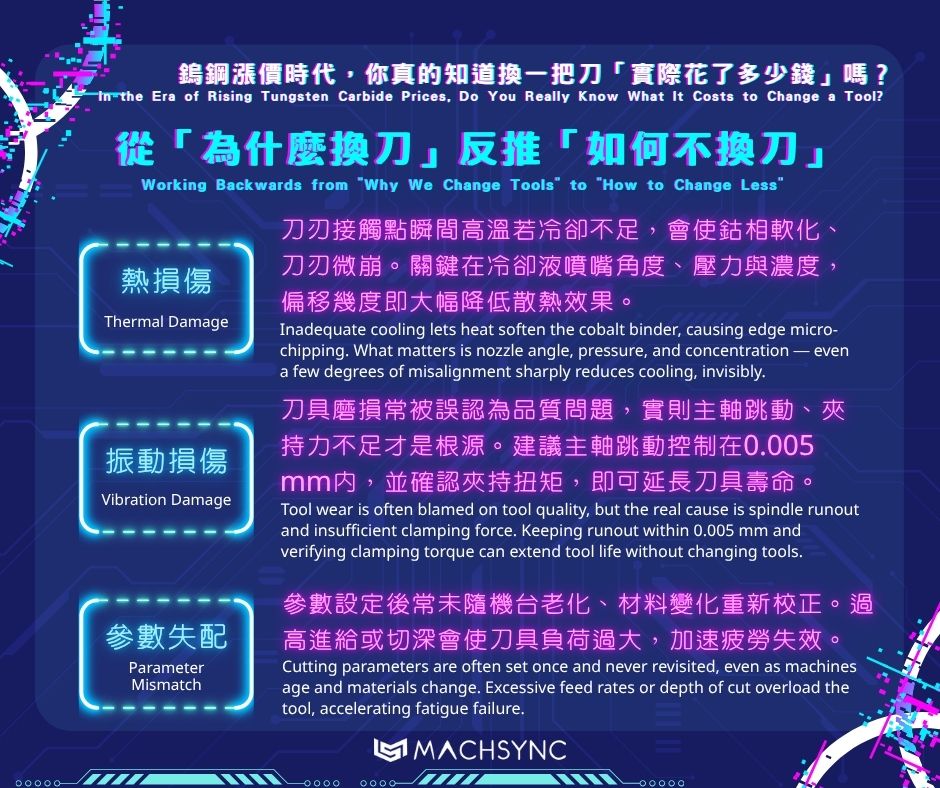
    1.  Thermal Damage: The Invisible Killer
      During cutting, the contact zone between the cutting edge and the workpiece reaches extremely high localized temperatures in an instant. When cooling conditions are inadequate, heat accumulates continuously, gradually softening the tungsten carbide binder phase (cobalt), which leads to micro-chipping of the cutting edge and accelerated wear. Many shops assume that "as long as coolant is spraying, it's fine" — but the angle, pressure, and concentration of the coolant are what truly matter. If the coolant nozzle is misaligned by even a few degrees from the cutting zone, the thermal management effect drops dramatically — and this is nearly impossible to detect from visual inspection alone.
    2. Vibration Damage: The Problem Comes from the Machine, Not the Tool
      When a tool wears out faster than expected, the first instinct in many factories is "this batch of tools must be poor quality." What gets overlooked is that vibration is often the root cause. Insufficient clamping force in the tool holder, excessive spindle runout, or inadequate rigidity in the workholding fixture — all of these cause the cutting tool to absorb irregular impact forces with every pass. This kind of high-frequency micro-vibration damages the cutting edge far more severely, and far less predictably, than steady-state wear.
      Regularly measuring spindle runout (recommended tolerance: within 0.005 mm) and verifying that tool holder clamping torque meets specification can significantly extend tool life — often without changing a single tool.
    3. Parameter Mismatch: The Cost of "Set It Once and Run It to Failure"
      In many factories, once a machining program enters mass production, the cutting parameters are never revisited. Yet as machines age, tooling brands change, or incoming material batches shift, what were once optimal parameters may no longer be appropriate. Excessively high feed rates or depths of cut force the tool to absorb stresses beyond its design limits with every single cut, accelerating fatigue failure.

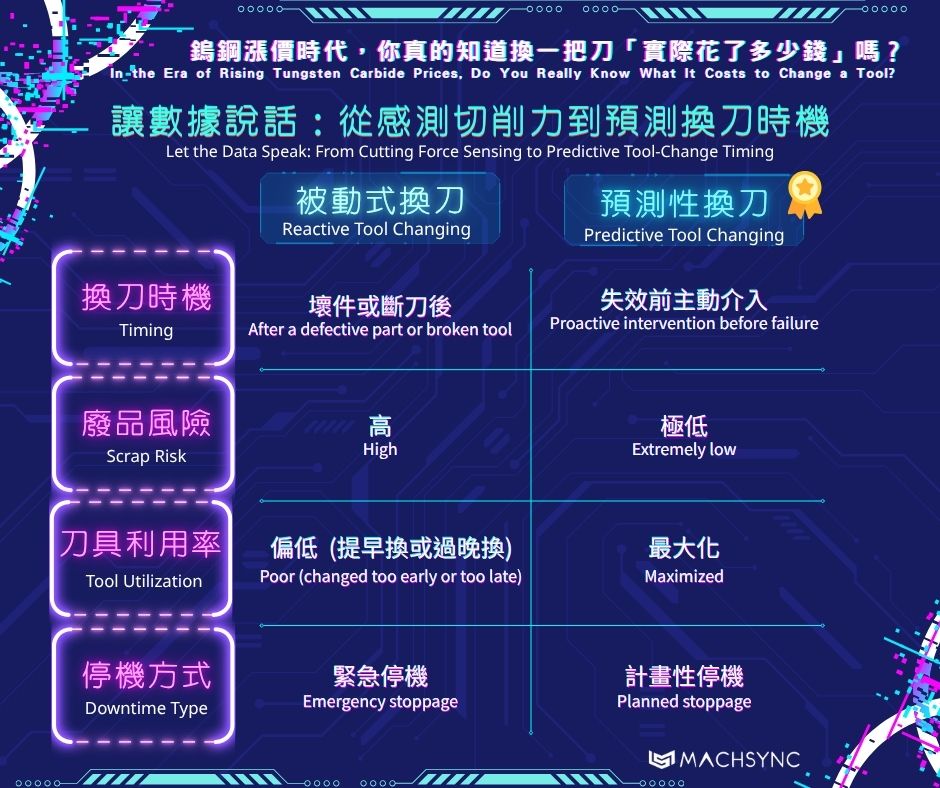
    Let the Data Speak: From Cutting Force Sensing to Predictive Tool-Change Timing

    In the past, the decision of when to change a tool depended on the operator's senses — eyes scanning for edge wear, ears listening for abnormal cutting sounds, fingers feeling workpiece surface roughness. These methods are not without value, but they carry two critical weaknesses : the timing is usually too late, and the judgment cannot be standardized or replicated.


    Today's intelligent machining technology allows us to capture, in real time, the true loads a tool is experiencing while it is still spinning — including the dynamic changes in bending moment, axial force, torque, and temperature. When these data signals begin trending toward anomaly, it means the tool is heading toward failure — even at a point when workpiece dimensions may still appear within tolerance.


    This is the essential difference between predictive tool changing and reactive tool changing:

    When tool changes can be planned, they can be scheduled during shift changeovers or line transitions — meaning the same activity no longer consumes any productive machining time. This is the core thinking behind genuinely effective tooling cost control in

    Redefining "Saving on Tooling Costs"

    When confronted with the reality of persistently rising tungsten carbide prices, the most common reactions in factories are: "Find cheaper tools" or "Push each tool as far as it will go." Both paths carry real risk. The former may lead to unstable tool quality and higher scrap losses. The latter risks turning what could have been a planned tool change into an emergency shutdown — compounded by scrapped workpieces.


    Truly effective cost control has never come from squeezing the purchase price. It comes from recovering the value that is silently leaking away at every stage of the machining process.

    The cost of a tool is the entry point to manufacturing expense. But the management of that tool is where profit finds its exit.

    Sources: Public domain references

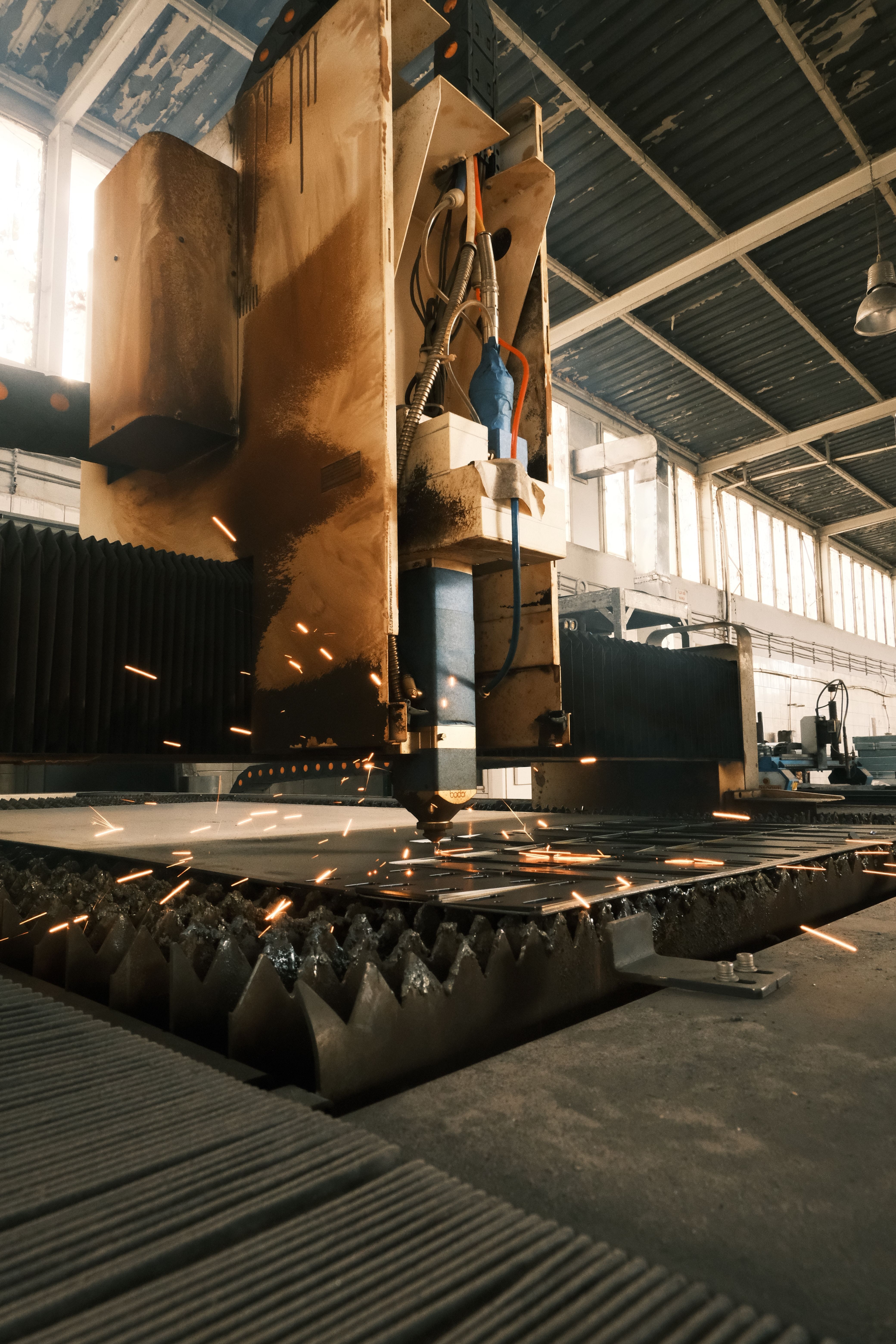
    Photo by Ahmet Çiftçi / Machsync

    This article is original content created by Machsync. It may not be used for commercial purposes or distributed, shared, or sold in any form. Unauthorized reproduction, excerpting, copying, or use in any visual format is strictly prohibited.

    For reprint or licensing inquiries, please contact Machsync.

    ﹌﹌﹌﹌﹌﹌﹌﹌﹌﹌﹌﹌﹌﹌﹌

    📬 Get in Touch with Machsync

    📍 2F., No. 38, Keya Rd., Daya Dist. Taichung City, Taiwan

    📞 +886-4-2473-6883

    ✉️ admin@machsync.ai