









Search

Please enter a keyword or what you are looking for in the field below to search.

alt
Search result
There is no result for your search, please check again.
    alt alt alt alt
    alt alt alt alt
    alt

    Preserving Machining Expertise Through AI: When a Master's Intuition Becomes Replicable Data

    As the global manufacturing industry accelerates toward smart manufacturing and AI-driven operations, the challenge of knowledge transfer is becoming more critical than equipment upgrades themselves. Many of the most valuable process capabilities do not exist in SOPs or documentation — they live within the intuition and judgment developed by veteran machinists over decades of hands-on experience. Yet as skilled workers retire and the talent gap widens, this tacit knowledge is disappearing from factory floors at an alarming rate.

    Scroll

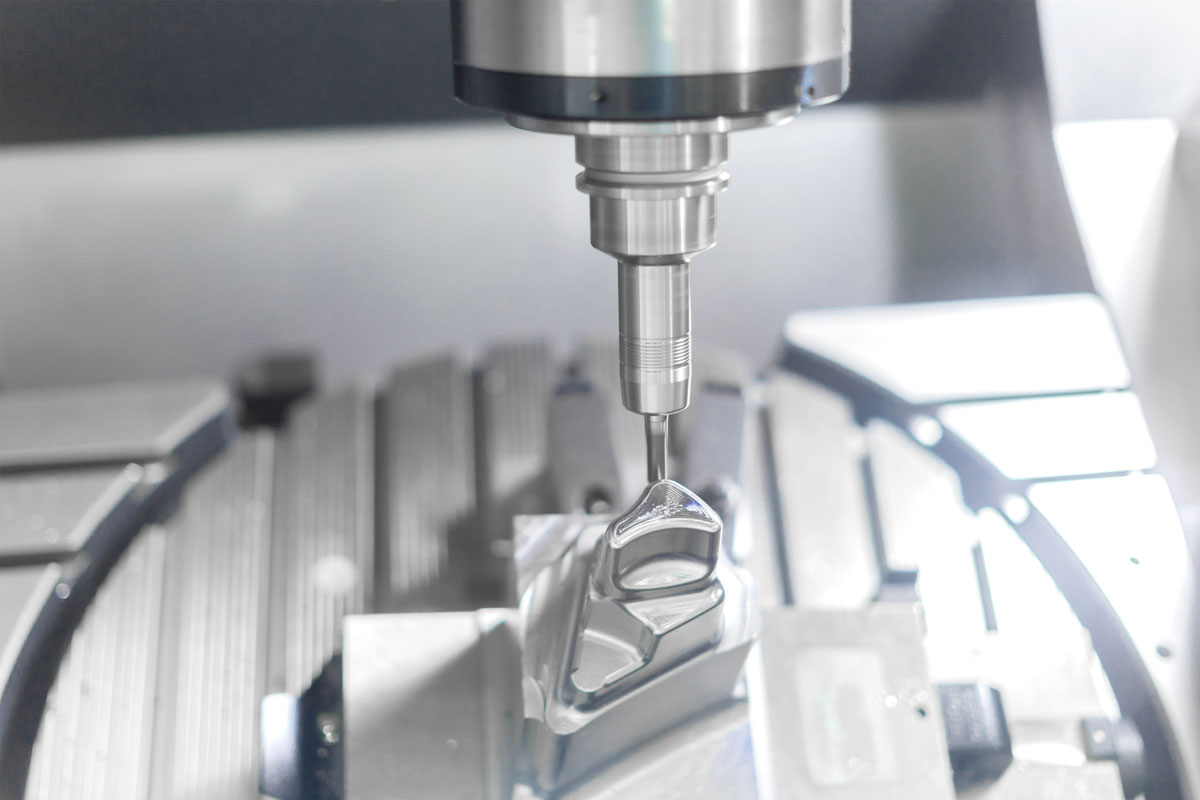
    There is a kind of knowledge that lives in a veteran machinist's fingertips. The moment a cutting tool bites into steel, he can tell from the sound alone whether the spindle speed is right. A faint tremor in the machine bed tells him whether a tool offset

    And across the manufacturing industry, it is disappearing — retiring alongside tens of thousands of veteran machinists every year.

    Until now, there was no precise enough tool to capture knowledge that resists being put into words. Machsync Technology's multi-sensor AI was built to solve exactly that problem — not by filming what a master machinist does, but by listening to what his machines say, and then teaching an AI to speak that language.

    Central proposition: Experience isn't memory — it's a pattern of judgment. Quantify the pattern, and you've achieved real knowledge transfer.
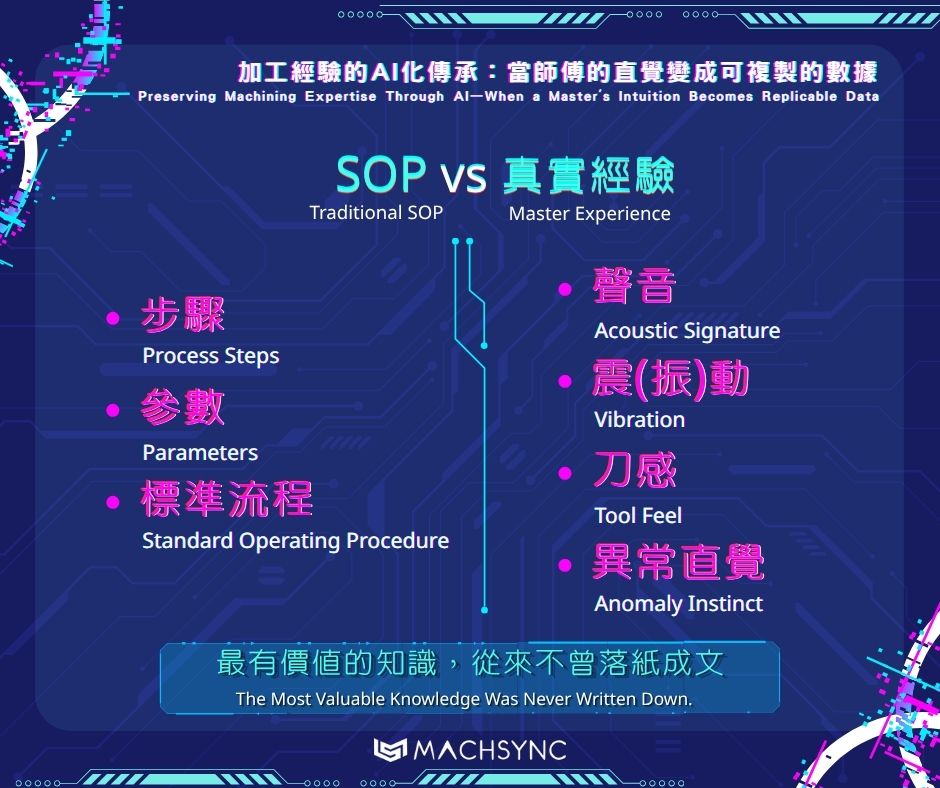
    Why a Master's Experience Can't Be Written Into an SOP

    Traditional knowledge transfer has always relied on two approaches: written SOPs and the apprenticeship model.

    SOPs capture steps but not the reasoning behind decisions; apprenticeships transmit feel but are constrained by time and a shrinking pool of experienced mentors.

    The root problem is the nature of tacit knowledge itself. When the brain executes a highly practiced skill, it compresses complex sensory input into intuitive responses, bypassing language entirely. Ask a master machinist how he knows a tool offset needs adjusting, and his honest answer is often "it just feels off." That isn't evasiveness — it's an accurate description of how expertise actually works.

    Research suggests that traditional SOPs cover only around thirty percent of the process knowledge that matters most on the floor. The other seventy percent lives in the machinist's senses — and retires with him.

    The Logic of Sensing AI: Teaching Machines to Feel What Masters Feel

    Machsync Technology's breakthrough came from reframing the central question.

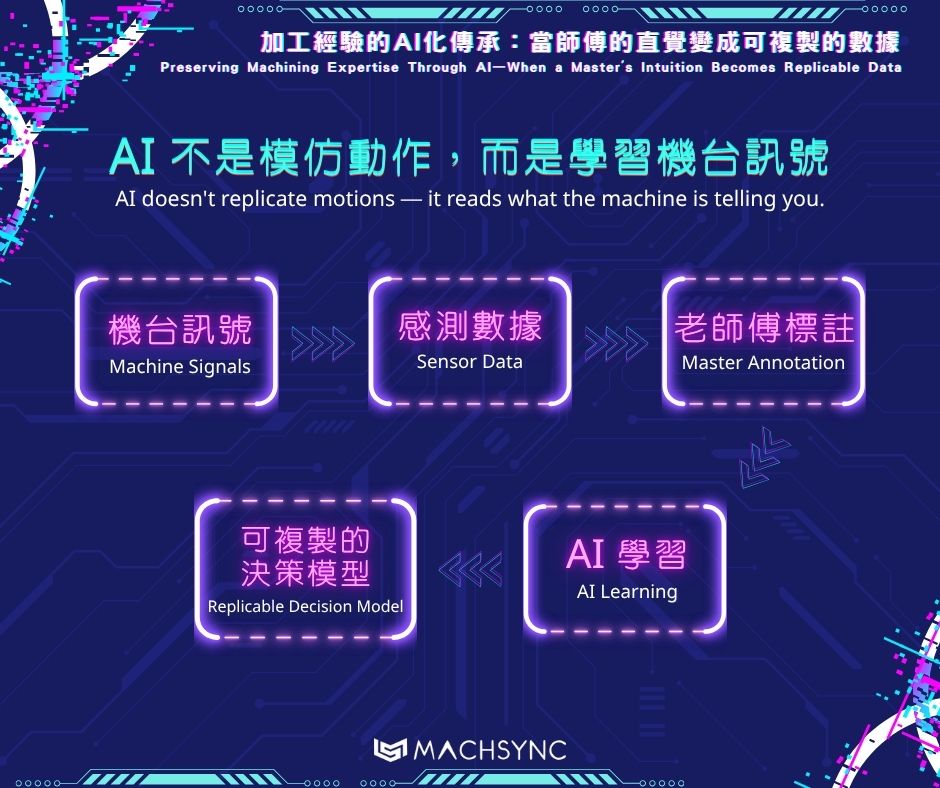
    Instead of asking "what does the master machinist know?", the system asks "what signals was the machine producing when the master made his call?"

    Vibration, acoustic signatures, spindle current, temperature — these physical signals are objectively present in the machine before any human judgment is rendered. Machsync's sensing AI has the machinist apply simple labels during the machining process ("good / bad," "compensate / no compensation needed"), then trains on thousands of paired observations — machinist verdict alongside concurrent sensor data — to reverse-engineer the underlying decision logic.

    The result is a decompression of decades of intuition into a deployable, replicable model.

    Key insight: The value of sensing AI isn't that it's smarter than a master machinist — it's that it has something a master machinist doesn't: it never tires, never forgets, and can monitor every machine simultaneously. The master sets the gold standard; the AI delivers it at scale.

    From Apprenticeship to Model Deployment

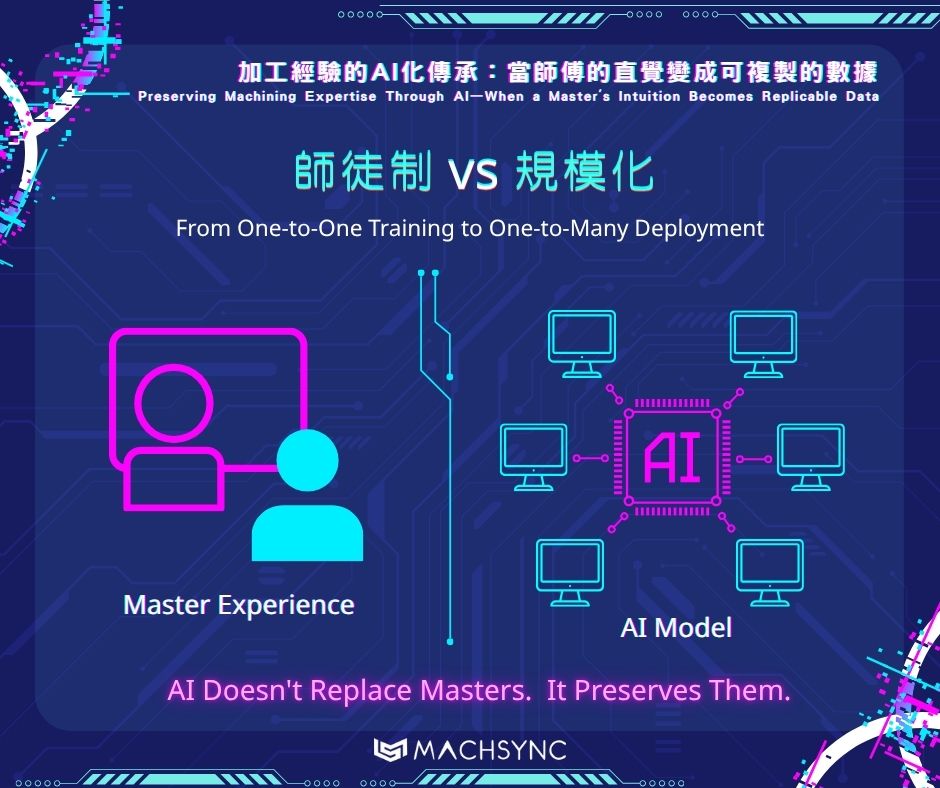
    In the traditional apprenticeship model, knowledge travels in series — one person to one person — with something lost at every handoff. When the master retires, the gap resets to zero.

    Sensing AI enables parallel deployment. A single master's judgment logic can run simultaneously across ten machines, a hundred machines, without interruption and without the master's presence — and it doesn't degrade over time.

    The skills gap isn't really about a shortage of people. It's about the non-scalability of expert judgment. Sensing AI makes expert judgment scalable for the first time.

    Three Tiers of Sensing Intelligence

    Machsync Technology organizes sensing AI capability into three progressive tiers

    1. Descriptive

    Real-time monitoring that answers "what is happening right now?"


    2. Diagnostic

    Cross-referenced against historical data to answer "why is it happening?"


    3. Predictive

    Forecasting remaining tool life, recommending parameter adjustments, and proactively intervening on feed rates. This is where the master machinist's judgment logic is genuinely replicated.

    AI Is Not Here to Replace the Master

    Sensing AI only works because master machinists exist. Without their annotations, there is no training data. Without training data, there is no effective model. The master isn't a candidate for replacement — he is the source. He is the only person with the authority to define what good machining actually looks like.

    What changes is how knowledge travels. In the past, a master's expertise could only reach the apprentice standing beside him. Now it can be encoded into a model and delivered to every connected machine on the floor, every new hire, every employee who hasn't joined the company yet.


    The real challenge of knowledge transfer has never been memory — it's replicating expert judgment across time and distance. Masen Technology's sensing AI makes that possible for the first time.

    Sources: Public domain references

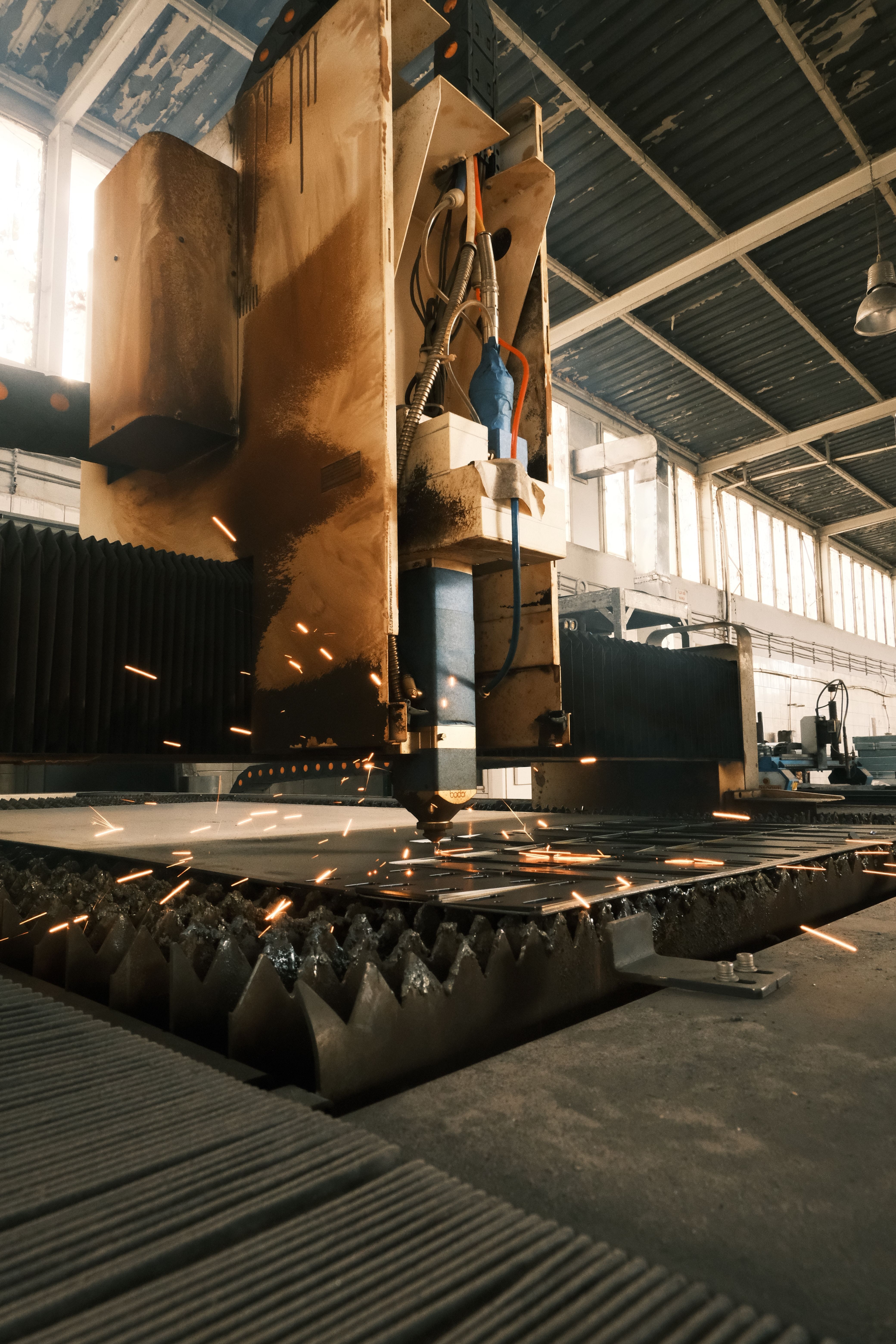
    Photo by Denys Gromov / Machsync

    This article is original content created by Machsync. It may not be used for commercial purposes or distributed, shared, or sold in any form. Unauthorized reproduction, excerpting, copying, or use in any visual format is strictly prohibited.

    For reprint or licensing inquiries, please contact Machsync.

    ﹌﹌﹌﹌﹌﹌﹌﹌﹌﹌﹌﹌﹌﹌﹌

    📬 Get in Touch with Machsync

    📍 2F., No. 38, Keya Rd., Daya Dist. Taichung City, Taiwan

    📞 +886-4-2473-6883

    ✉️ admin@machsync.ai