







Search

Please enter a keyword or what you are looking for in the field below to search.

alt
Search result
There is no result for your search, please check again.
    alt alt alt alt
    alt alt alt alt
    alt

    From Reactive Tool Changes to Proactive Prediction: How Smart Toolholders Secure Delivery Commitments Across the Supply Chain

    Unexpected tool breakage and excessive wear are the leading causes of unplanned downtime in machining operations — and the hidden root of missed delivery dates. This article explains how smart toolholders transform reactive tool changes into proactive predictions, enabling suppliers to offer more reliable delivery commitments without large-scale equipment overhauls, and to become indispensable partners in the supply chain.

    Scroll

    Late Deliveries Are Often Not a Scheduling Problem

    A complaint procuremet teams hear all too often: "You promised this delivery date — and you've missed it again."

    The reality on the supplier side is usually this: the schedule was set, the machines were running, but a tool suddenly snapped, or machined tolerances began to drift and an entire batch had to be scrapped and redone — and it all happened in the final days before the deadline.

    This is not a scheduling capability problem. It is a production predictability problem.

    And the cutting tool is the single most overlooked element — yet the most likely trigger of unplanned downtime.
    The Systemic Blind Spots of Traditional Tool Change Practices

    Most machining shops today still rely heavily on operator intuition and fixed-interval schedules to decide when to change tools — swapping after a set number of parts, or when the operator feels it is "about time."

    This approach may have been sufficient in the era of small batches and slower production, but under the pressures of modern supply chains, it carries two unavoidable structural flaws:

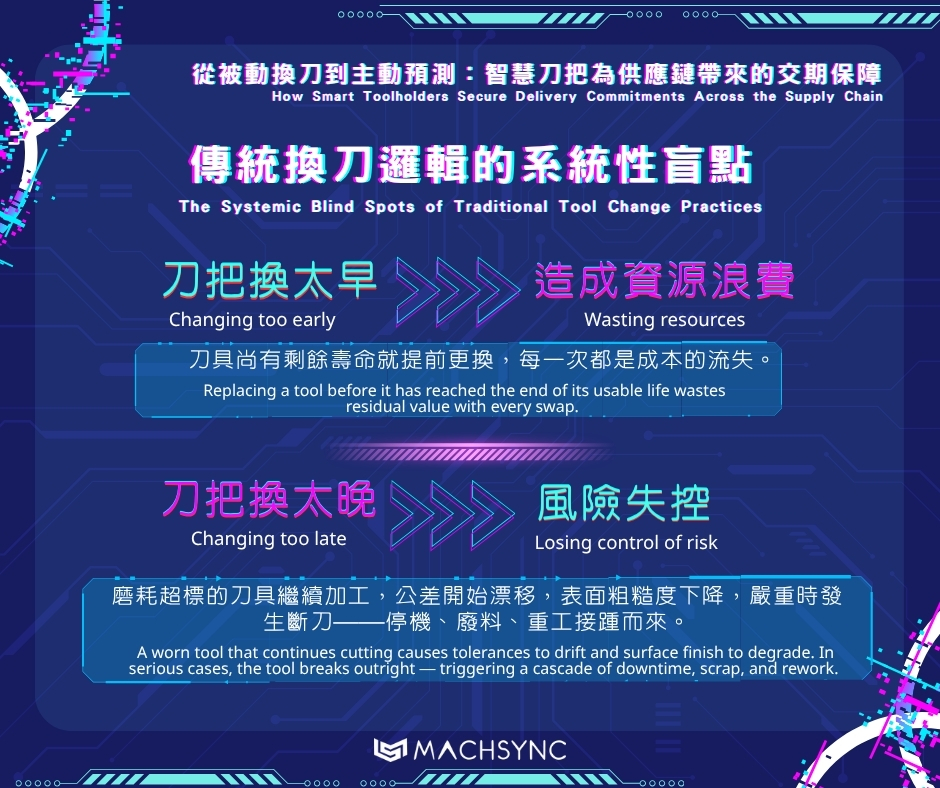
    Changing too early — wasting resources

    Replacing a tool before it has reached the end of its usable life wastes residual value with every swap. For high-cost tooling, this adds up to a significant hidden expenditure over time.

    Changing too late — losing control of risk

    A worn tool that continues cutting causes tolerances to drift and surface finish to degrade. In serious cases, the tool breaks outright — triggering a cascade of downtime, scrap, and rework. These incidents almost always occur during the window when the operator believed the tool "still had life in it."


    Both situations are happening simultaneously. But without visible data, managers have no idea how severe the problem actually is, and no clear path to improvement.

    The Smart Toolholder: Bringing Sensing Capability Into the Tool Itself

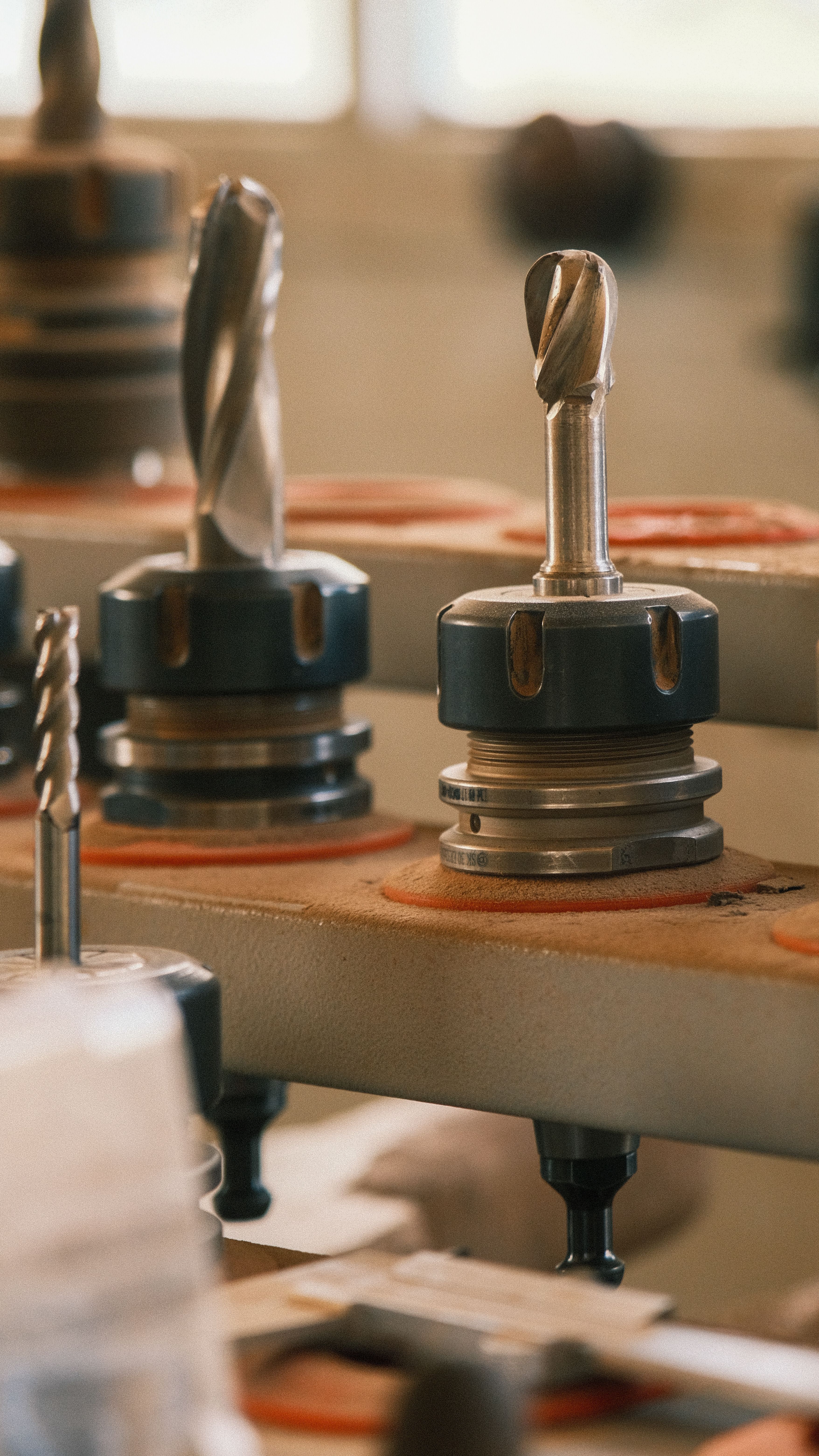
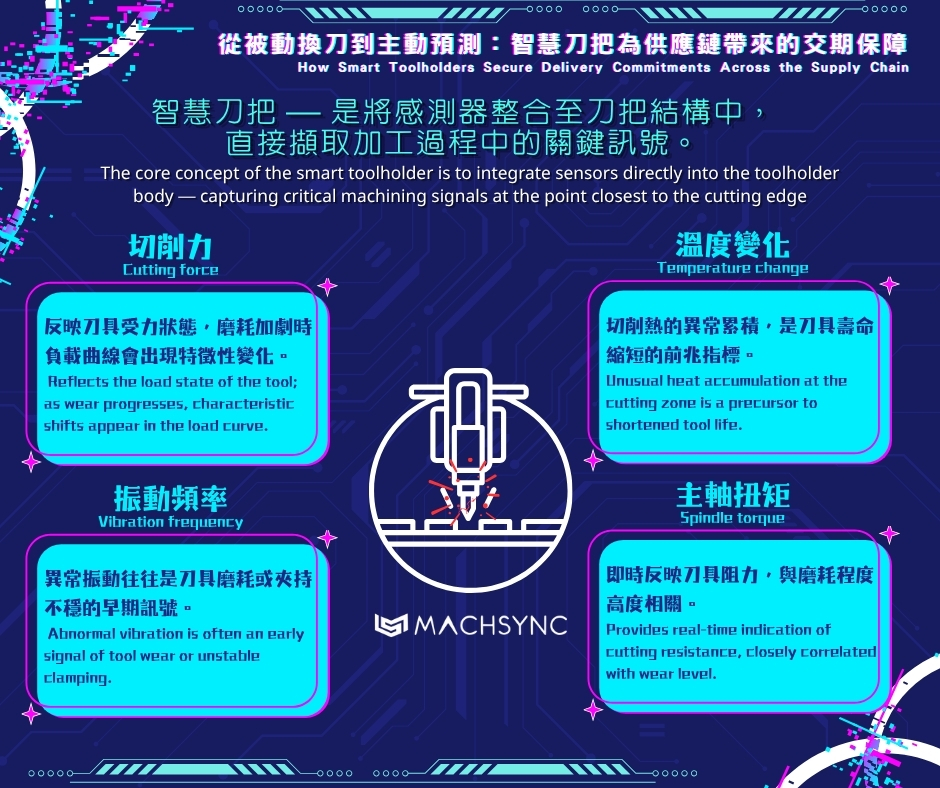
    The core concept of the smart toolholder is to integrate sensors directly into the toolholder body — capturing critical machining signals at the point closest to the cutting edge:

    • Cutting force : Reflects the load state of the tool; as wear progresses, characteristic shifts appear in the load curve
    • Vibration frequency : Abnormal vibration is often an early signal of tool wear or unstable clamping
    • Temperature change : Unusual heat accumulation at the cutting zone is a precursor to shortened tool life
    • Spindle torque : Provides real-time indication of cutting resistance, closely correlated with wear level


    These signals are continuously transmitted from the smart toolholder — no machine retrofitting required, no bulky external sensor systems needed. Compatibility with existing machining centers is built in.


    The key advantage of the smart toolholder lies in the proximity of its data source. The closer the sensing point is to the cutting edge, the more accurately it reflects the true condition of the tool — rather than relying on indirect inference from distant signals like spindle motor current.

    From Sensing to Prediction: How Data Becomes a Tool Change Decision

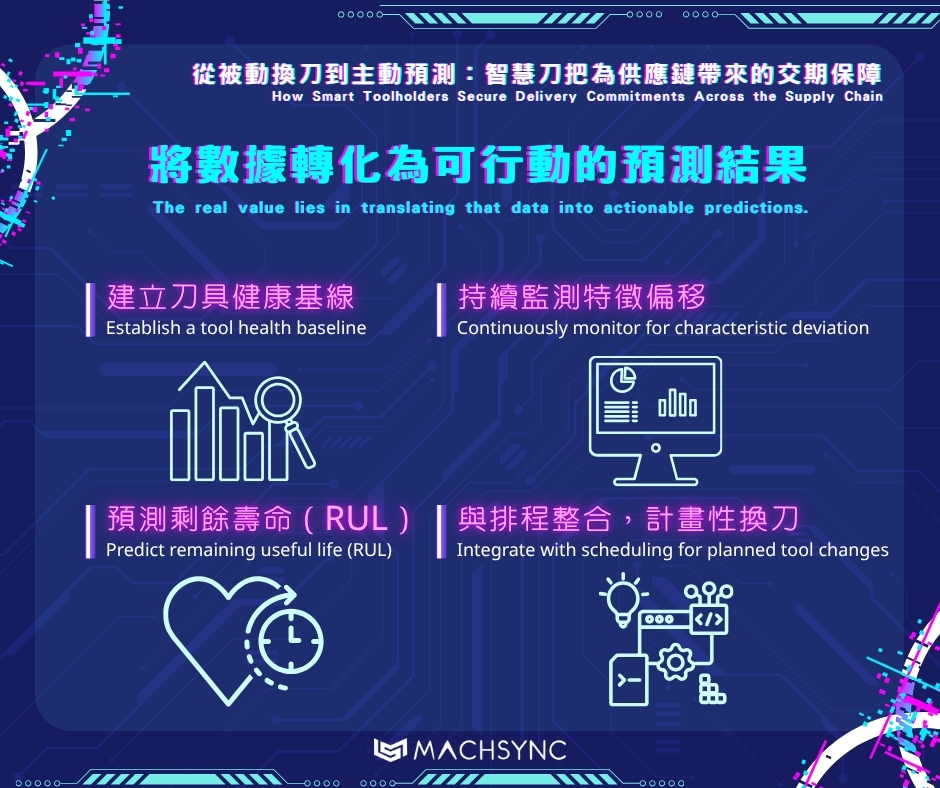
    Having sensor data is only the first step. The real value lies in translating that data into actionable predictions.

    The predictive logic of a smart toolholder system works roughly as follows:


    ① Establish a tool health baseline

    Record the normal range of each signal parameter when the tool is brand new, creating a reference point for all subsequent comparison.

    ② Continuously monitor for characteristic deviation

    During machining, the system tracks trend changes in cutting force, vibration, and other features — identifying the rate at which wear is accumulating.

    ③ Predict remaining useful life (RUL)

    By combining historical tool change data with the current wear rate, the system estimates how many more hours or parts the tool can safely produce, and issues a proactive replacement recommendation before the warning threshold is reached.

    ④ Integrate with scheduling for planned tool changes

    Tool changes are no longer sudden necessities — they become planned intervals built into the production schedule, making tool replacement part of the production rhythm rather than an interruption of it.


    This closed loop transforms reactive "change it when it breaks" into proactive "change it at exactly the right moment."

    What This Means for the Supply Chain: Delivery Commitments with Confidence

    Unplanned downtime drops significantly — delivery variance narrows

    When a tool breaks or wears beyond limits unexpectedly, recovery typically takes anywhere from a few hours to half a shift — reloading the tool, re-referencing offsets, verifying the first-off part. Every one of these steps consumes buffer time that was already tight.


    After adopting smart toolholder prediction, the frequency of unplanned tool change events drops markedly. This does not mean tools are never changed — it means tool changes shift from unexpected incidents to scheduled activities that no longer disrupt production flow.


    Delivery variance narrows as a result, and a supplier's external delivery commitments move from "we'll try our best" to "we're confident we'll hit it."

    Consistent quality reduces the risk of customer complaints

    Tolerance drift is the most common quality impact of tool wear — but it does not appear suddenly. It creeps in gradually. Under traditional management, the interval between "quality already declining" and "problem finally detected" may have already produced a batch of non-conforming parts ready to ship.


    The continuous monitoring of the smart toolholder compresses this gray zone substantially. The system raises an alert at the early onset of quality deviation, enabling operators to intervene before scrap occurs.


    With more stable outgoing quality, complaint volumes and return rates naturally decrease — and the value of retaining long-term customer relationships far outweighs the tool cost savings alone.

    Visible data gives proof to "we manage our processes well"

    In the past, when a supplier said "our quality is excellent and our management is rigorous," it was a verbal promise — and the customer had no choice but to verify it through incoming inspection.


    With a smart toolholder system in place, suppliers can now provide: the full usage history of every tool, the data-driven basis for each tool change decision, and quality trend charts across machining runs — all of it process transparency that can be shown directly to the customer.


    In supplier qualification reviews, customer audits, or new order negotiations, this transparency converts directly into a trust advantage — helping suppliers win contracts at equivalent pricing.

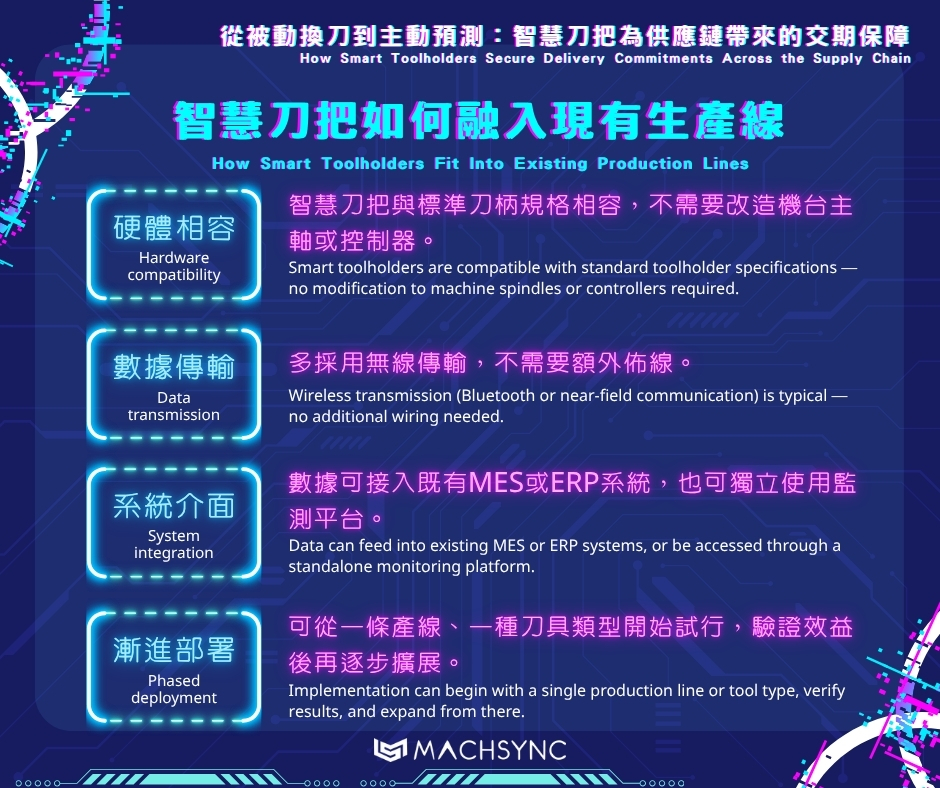
    How Smart Toolholders Fit Into Existing Production Lines

    When manufacturers hear "smart manufacturing," the instinctive concern is: "Will this require major changes to how we currently operate?"

    The design philosophy of smart toolholder adoption is **minimum disruption to existing operations**:


    • Hardware compatibility: Smart toolholders are compatible with standard toolholder specifications — no modification to machine spindles or controllers required
    • Data transmission: Wireless transmission (Bluetooth or near-field communication) is typical — no additional wiring needed
    • System integration: Data can feed into existing MES or ERP systems, or be accessed through a standalone monitoring platform
    • Phased deployment: Implementation can begin with a single production line or tool type, verify results, and expand from there


    No production line shutdowns for retrofitting. No factory-wide replacement at once. The first smart toolholder deployment can go live while normal production continues.

    From Supplier to Strategic Partner: A New Dimension of Differentiation

    Competition in Taiwan's precision machining industry has long focused on three dimensions: machine specifications, machining accuracy, and pricing. But the gap between competitors on all three of these dimensions is narrowing rapidly.


    Smart toolholders introduce a fourth dimension: the predictability and transparency of the production process itself.


    A supplier that can proactively tell customers "here is the status of your order, here is where the delivery risk sits, and here is how we are managing it" is offering more than a machining service — it is offering a stable, accountable node in the supply chain.


    For brand owners and system integrators who are actively building supply chain resilience, this kind of supplier is worth deeper, longer-term partnership — not just the next purchase order.

    Proactive Prediction Is the Most Tangible Promise You Can Make

    Delivery assurance has never been purely a scheduling issue. It is an expression of the entire production management capability behind it.


    Smart toolholders transform tool changes — something that happens every single day — from "decided by operator feel" to "decided by data." They transform unplanned stoppages from "occasional accidents" into "foreseeable risks that can be prevented."


    This transformation does not require replacing a single machine. But it enables suppliers to say something to their customers with genuine confidence: "This delivery date — we will deliver."

    Sources: Public domain references

    Photo by Cemrecan Yurtman/ Khwanchai Phanthong / Machsync

    This article is original content created by Machsync. It may not be used for commercial purposes or distributed, shared, or sold in any form. Unauthorized reproduction, excerpting, copying, or use in any visual format is strictly prohibited.

    For reprint or licensing inquiries, please contact Machsync.

    ﹌﹌﹌﹌﹌﹌﹌﹌﹌﹌﹌﹌﹌﹌﹌

    📬 Get in Touch with Machsync

    📍 2F., No. 38, Keya Rd., Daya Dist. Taichung City, Taiwan

    📞 +886-4-2473-6883

    ✉️ admin@machsync.ai

    🌐 machsync.ai/tw